
Ample Kitchen's Systemic Food Economy Reform Model

Ample Kitchen's unique, pro-social model is designed to contribute to systemic change in the food economy by addressing issues of waste, equity, nutrition, and environmental impact on a massive scale, extending well beyond its primary B2B sales channel (Ample Marketplace).
The overall purpose of Ample is to change the failing food system by striking a balance between commercial and social outcomes, aiming to make profit work for people and the planet. Ample seeks to build a new ecosystem that values every harvest, working toward a vision where there is no such thing as food waste.

Here is how Ample Kitchen's model, as part of the broader Ample mission, contributes to systemic change:
1. Disrupting the Food Supply Chain and Reducing Environmental Impact
Ample Kitchen will act as a scalable, practical solution to food waste that helps reform the current system.
Waste Prevention and Climate Action: Ample Kitchen, by acquiring a dedicated food production facility, will rescue, revalue, and repurpose as much unsold farm surplus as possible. This process directly prevents waste and cuts Greenhouse Gas (GHG) emissions. The goal is to enable the rescue and reuse of at least 7% of UK unsold farm surplus and reduce UK CO2e emissions by more than 250,000 tonnes by 2030.
Buffering the Supply Chain: The facility will use high-volume production and blast chill/freeze technology to massively extend the life of fresh produce that would otherwise go to waste. This freezing capacity creates a valuable flexible buffering effect in the wider supply chain, directly reducing farm food waste.
Supporting Sustainable Goals: Ample's mission is directly relevant to eight of the UN Sustainable Development Goals (SDGs), including SDG 12 (Responsible consumption and production) and SDG 13 (Climate action).
2. Promoting Economic Fairness and Farmer Equity
The model addresses economic inequality by seeking a more equitable food economy and ensuring fairness for everyone in the food chain.
Empowering Farmers: Ample puts growers in control of their own food prices and provides prompt settlements in days, not months, unlike traditional models.
Generating Revenue: A specific sustainable impact target is to empower UK farmers to realise £195 million extra revenue.
Incentivising Sustainability: Ample Kitchen incentivises growers by offering a profit share scheme when supplies are offered on a consignment basis. When farmers are paid fairly for all their crops, they gain the opportunity to grow their food using more sustainable, regenerative, and ethical methods.
3. Enabling Social Impact and Enhancing Public Welfare
Ample Kitchen focuses on "pro-social food production" with a goal of enabling social impact on a massive scale.
Fighting Poverty through Donation: Ample utilises a "Pay it forward" scheme, a take on BOGOF (Buy One, Give One Free), where Ample meals will be available to donate to social causes fighting poverty.
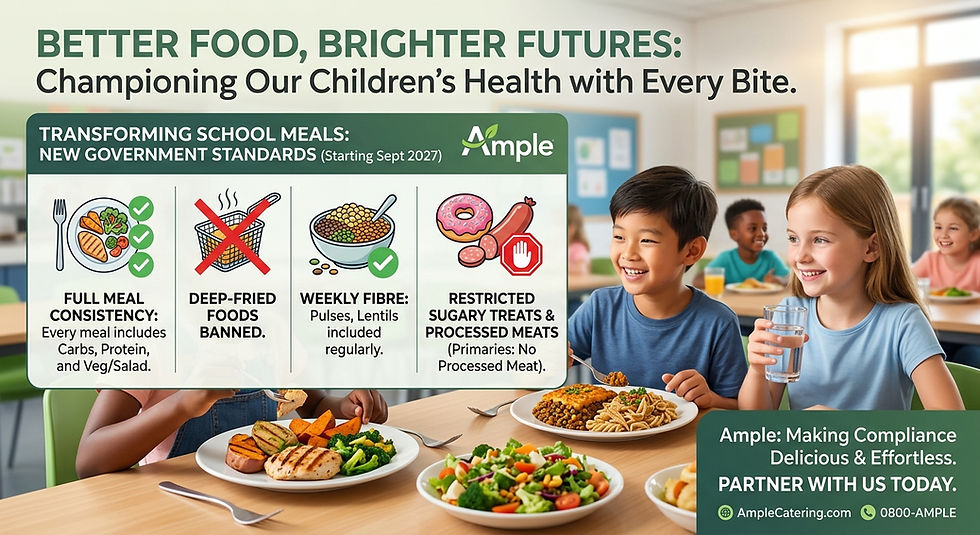
Massive Nutritional Enhancement: The model targets the public sector (schools and hospitals) with high-quality, nutritious meal components made from surplus ingredients.
Academic research confirms that enhancing the diets of vulnerable and marginalised people (patients, pupils, and prisoners) leads to substantial social and economic benefits, including improved health, wealth, and welfare.
Ample Kitchen products are designed to be abundant in vegetables and legumes, offering superior nutrition and options like low-sodium, high-protein, and allergen-free recipes, which appeal specifically to institutional needs.
This focus is relevant to SDG 1 (No poverty), SDG 2 (Zero hunger), and SDG 3 (Good health and well-being).
4. Advocacy and Systemic Reform
Ample seeks beneficial change by actively challenging the status quo and building broad community support.
Campaigning and Awareness: Ample will build awareness through a campaigning message, leveraging social and direct media. The objective is to build grass-roots support and endorsement by engaging consistently with both online and offline communities to build trust and credibility.
Exposing Food Waste: Ample plans to expose the "scandal of food waste" by sharing the facts and encouraging partners, families, and community activists to support its mission, demonstrating how to change the current system.
Challenging Standards: Ample Kitchen highlights that the quality of food in schools and hospitals is often inadequate, arguing that these places need the most nutritious food. By producing affordable, high-quality, nutritious meal components, Ample Kitchen offers a compelling solution that cuts the cost of meal production while enhancing quality and nutrition.
Ref: Circular Economy for Food: A Systemic Interpretation of 40 Case Histories in the Food System in Their Relationships with SDGs https://www.mdpi.com/2079-8954/7/3/43


Comments